
A living testament to Satavahana Grandeur: Kondapur
The Telangana region has, since ancient times, been a major centre of spirituality, particularly of Buddhism. Among the prominent Buddhist sites spread across the Krishna and Godavari river basins such as Phanigiri, Nelakondapalli, Badankurti and Dhulikatta Kondapur holds a distinctive place. More than a religious centre, Kondapur emerged during the Satavahana period as a major urban hub of international trade and as an important coin minting centre (tankashala). Even today, stupas, chaityas and Roman coins found here stand as living evidence of Telangana’s ancient cultural and economic links with the wider world.
Located in Sangareddy district, Kondapur is among the oldest urban centres of present-day Telangana and a living testimony to the grandeur of the Satavahana era and the prominence of Buddhism. Over 2,000 years ago, it flourished not merely as a village but as a thriving metropolis and a key node in international commerce. During the reign of the Satavahana emperors, the region played a crucial political, economic and religious role. Now buried beneath earthen mounds, the site mirrors the advanced civilisation of ancient Telangana.
Kondapur lies about 15 km from the Sangareddy district headquarters. The site can be reached by travelling 8 km from Peddapur via the Hyderabad–Zaheerabad National Highway (NH 65). Its location in the Manjeera and Musi river basin enabled strong connectivity through both waterways and land routes, linking it to ports such as Machilipatnam. Greek ambassador Megasthenes, in his work Indica, noted that the Satavahanas ruled cities fortified with as many as 30 ramparts. Based on the earthen fortifications and defensive structures around Kondapur, historians believe it to be one of the prominent cities referred to by Megasthenes, also serving as a fortified centre during the Satavahana period.
The archaeological importance of Kondapur came to light in 1900, when British archaeologist Henry Cousens identified remains from the Mesolithic and Neolithic periods. Systematic excavations carried out in 1937 under the Nizam State Department of Archaeology, led by Khwaja Mohammad Ahmad, revealed the true scale of the ancient city. Excavations uncovered two Buddhist stupas measuring 15 feet and 19 feet in diameter, along with chaityas, viharas, Buddha’s footprints and pottery bearing the Triratna symbol. Pots inscribed with Brahmi script dating to the 1st century CE highlight the widespread presence of Buddhism in the region.
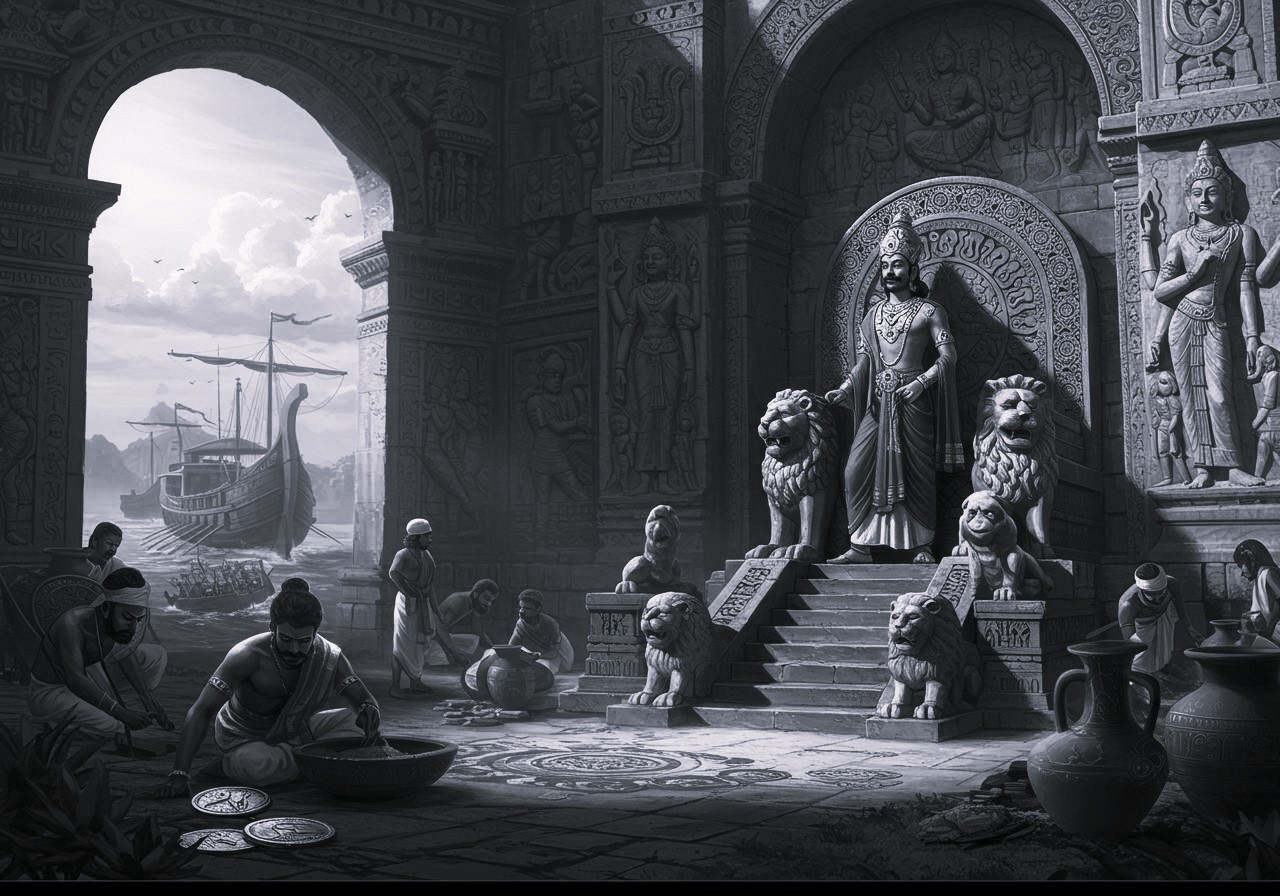
One of Kondapur’s most remarkable features is the discovery of thousands of coins. Large quantities of copper, silver and lead coins, along with clay moulds used for minting, clearly establish Kondapur as a major Satavahana mint. The recovery of 1,835 lead coins alone points to the economic prosperity of the period. The discovery of gold coins from the reign of Roman Emperor Augustus is particularly significant, underscoring strong trade links between ancient Kondapur and the Roman Empire. Goods were exported overseas via maritime routes through the port of Machilipatnam.
Terracotta figurines unearthed at the site including horses, elephants, Yaksha deities and Hariti (mother-and-child figures) reflect the artistic sensibilities of the time. Beads made of precious stones, ivory combs, bangles and earrings testify to a refined lifestyle and high levels of craftsmanship. Historians believe that the famed literary work Brihatkatha was composed here by Gunadhya, and that Satavahana ruler Hala governed from this region, indicating that Kondapur was not only a commercial hub but also a centre of administration and literary activity.
Kondapur’s prosperity as a trade centre was closely linked to its transport network. Situated between the Manjeera and Musi rivers, goods were transported via waterways to the Krishna River and onward to the eastern coastal port of Machilipatnam (ancient Masolia). From there, maritime trade connected the region to the Roman Empire and other Western countries. Satavahana coins bearing ship motifs further confirm the importance of maritime commerce. In addition to river routes, Kondapur lay along major land trade routes connecting western centres such as Kalyan and Paithan (Pratishthanapura) with eastern hubs like Dhanyakataka (Amaravati). Bullock carts and horse transport were commonly used, while Buddhist monasteries along these routes functioned as rest houses for traders and travellers.
The Kondapur Archaeological Museum houses exceptional artefacts from the Satavahana period, including copper, silver and lead coins, clay coin moulds, terracotta figurines, Yaksha sculptures, Hariti images, precious stone beads, shell bangles, ivory combs, iron tools and pottery inscribed with Brahmi script related to Buddhism. These exhibits offer valuable insights into the social and cultural life of the era.
The Satavahana Empire ruled large parts of southern India from around the 2nd century BCE to the 2nd century CE—nearly 450 years. Founded by Srimukha, the dynasty reached its peak under rulers such as Gautamiputra Satakarni, regarded as its most powerful king, while Hala enriched literature with works such as Gathasaptashati. Kondapur reached its zenith between the 1st century BCE and the 2nd century CE as a major trade and industrial centre, particularly for coin minting. Gautamiputra Satakarni, the 23rd Satavahana ruler, restored the dynasty’s declining prestige by defeating the Shakas and Yavanas, earning the title Kshatriya-darpa-mardana. The Nashik inscription commissioned by his mother Gautami Balashri states that his horses drank the waters of three seas (trisamudra-toya-pita-vahana), symbolising his extensive dominion across southern India.
Though Hindu by faith, the Satavahana rulers actively supported Buddhism, constructing stupas, chaityas and viharas. The 19-foot brick-and-stone stupa at Kondapur mirrors the architectural style of the Great Stupa at Amaravati, which later gave rise to the world-famous Amaravati school of art. Buddha’s footprints and Triratna symbols found at Kondapur confirm its role as a monastic and educational centre. Rock-cut cave temples at Ajanta, Karla, Nashik and Kanheri further reflect Satavahana architectural excellence, while viharas served as centres of learning, with places such as Nagarjunakonda and Dhanyakataka offering education at an advanced level.
Spread over nearly 100 acres, only about 5 acres of Kondapur have been excavated so far, with nearly 95 per cent still lying underground. Comprehensive excavations on the scale of Harappa or Mohenjo-daro could reveal many more historical treasures. There is a growing need for the Telangana government and the Archaeological Survey of India to develop Kondapur into a major heritage tourism destination. Once a centre of international trade, a Satavahana mint and a major Buddhist seat of learning, Kondapur stands as a powerful reminder of Telangana’s ancient glory, waiting to be fully unearthed and preserved for future generations.