
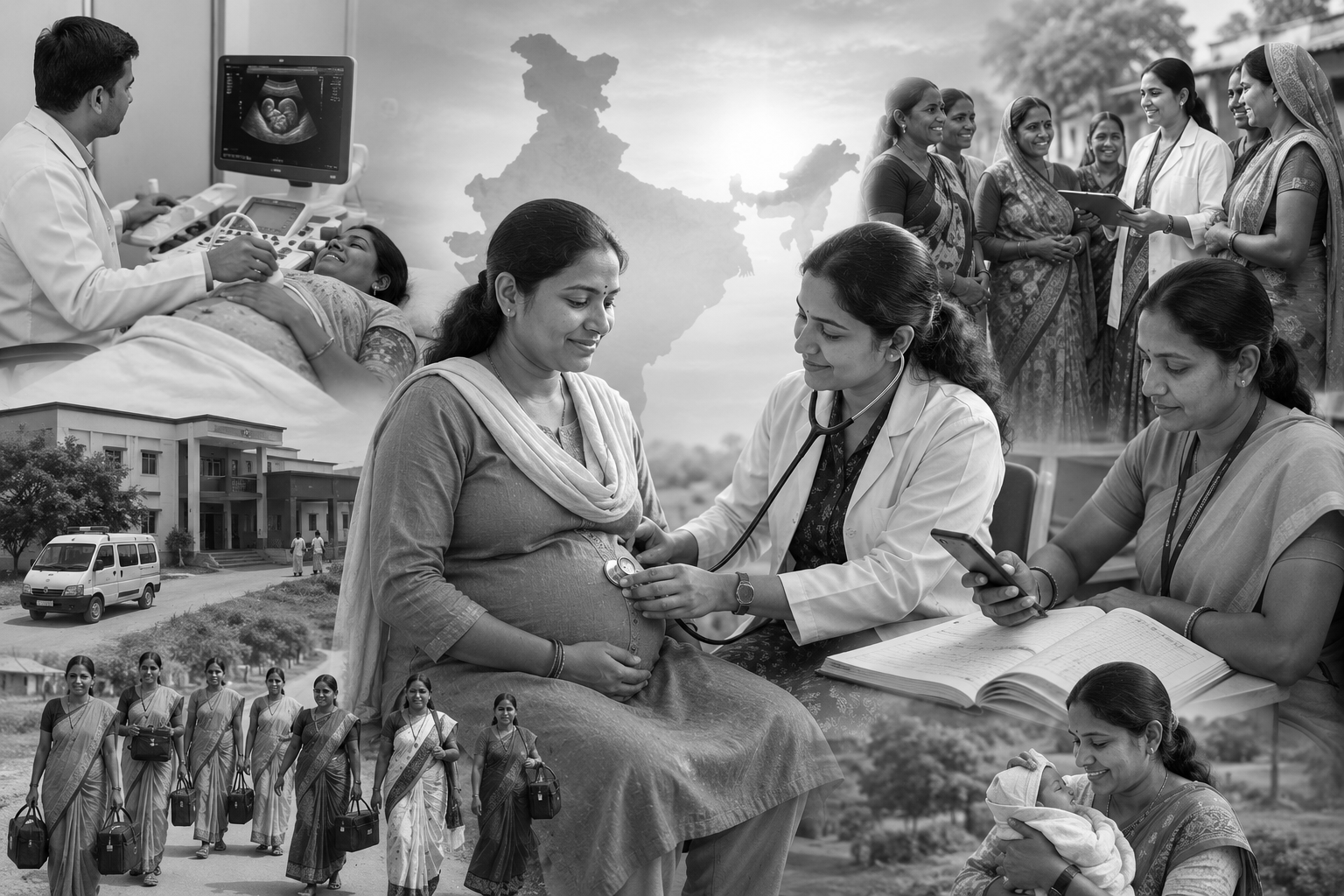
A Decade of Care: The Story Behind India's 86% Drop in Maternal Deaths
India's success in reducing maternal mortality did not happen through a single policy or programme. It was shaped by decades of healthcare reforms, expanding institutional deliveries, stronger community health networks, and increasing access to specialist care. Among these efforts, the Pradhan Mantri Surakshit Matritva Abhiyan (PMSMA) has emerged as a defining milestone. As the initiative completes ten years, it offers a window into how India's maternal healthcare strategy evolved from ensuring safe deliveries to ensuring safe pregnancies.
Launched by Prime Minister Narendra Modi on June 9, 2016 , PMSMA was designed to strengthen antenatal care by providing pregnant women with free specialist consultations on the 9th day of every month. Marking the programme's tenth anniversary, Union Health Minister J.P. Nadda launched nationwide celebrations under the theme "10 Years of PMSMA – A Decade of Care" and released a ₹75 commemorative coin and a ₹5 postal stamp to honour the initiative's contribution to maternal healthcare.
From High Mortality to Health Reform
India's maternal health journey has been remarkable. In the early 1990s, the country's Maternal Mortality Ratio (MMR) stood at nearly 400 deaths per 100,000 live births . Home deliveries were common, healthcare infrastructure was inadequate in many regions, and access to skilled birth attendants remained limited.
The first major turnaround came with the National Rural Health Mission (NRHM) and the Janani Suraksha Yojana (JSY) in the mid-2000s. These programmes encouraged institutional deliveries through financial incentives and strengthened rural healthcare networks through ASHA workers, ambulance services, and referral systems.
As more women began delivering in hospitals, maternal mortality declined sharply. India's MMR fell from 254 during 2004-06 to 212 during 2007-09 , and then to 167 during 2011-13 . However, health experts soon realized that hospital deliveries alone could not eliminate preventable maternal deaths.
Why PMSMA Was a Turning Point
By 2016, policymakers identified a critical challenge. Many women were reaching hospitals for delivery but remained unaware of serious conditions such as anaemia , gestational diabetes , pregnancy-induced hypertension , and cardiac complications that often became life-threatening during childbirth.
PMSMA was introduced to bridge this gap. The programme institutionalized specialist-led antenatal care and systematic screening for high-risk pregnancies. Women identified with complications could be referred to higher centres and monitored throughout their pregnancy.
This marked a fundamental shift in maternal healthcare policy. Instead of focusing only on safe deliveries, India began emphasizing safe pregnancies through prevention, early diagnosis, and timely intervention.
A Decade of Impact
Over the past ten years, PMSMA has grown into one of India's largest maternal healthcare initiatives.
According to official data, more than 7.5 crore antenatal check-ups have been conducted under the programme since its launch. Nearly 1.2 crore high-risk pregnancies have been identified, allowing healthcare workers to provide closer monitoring and specialist care.
The initiative has also benefited from strong public-private collaboration. More than 9,000 private healthcare providers have voluntarily joined PMSMA, helping expand access to specialist services in underserved and remote areas.
The results are reflected in key health indicators. Today, 95.9 percent of mothers receive antenatal care , while 65.2 percent receive at least four antenatal care visits during pregnancy. Early registration has also improved, with 76.2 percent of women registering during the first trimester . Meanwhile, institutional deliveries have reached 90.6 percent , indicating the broad reach of maternal healthcare services across the country.
Tracking Risk, Saving Lives
Recognizing the need for continuous monitoring, the government launched the Extended PMSMA (E-PMSMA) strategy in 2022.
The initiative transformed maternal care from a periodic service into an ongoing monitoring system. Under E-PMSMA, high-risk pregnancies are identified, line-listed, digitally tracked, and monitored until 45 days after delivery . SMS alerts, strengthened follow-up mechanisms, and greater support for frontline workers have improved continuity of care.
The programme has also expanded the number of high-risk pregnancy categories from 10 to 25 , enabling healthcare providers to detect a broader range of medical conditions and intervene earlier.
This evolution reflects India's increasing reliance on technology and data-driven public health systems to improve healthcare outcomes.
Building a Nationwide Maternal Health Safety Net
One of PMSMA's greatest strengths is its ability to leverage existing healthcare infrastructure rather than creating parallel systems.
The programme operates through a vast network of Primary Health Centres (PHCs) , Community Health Centres (CHCs) , district hospitals, medical colleges, and urban health facilities. Together with participating private hospitals, these institutions form a nationwide maternal healthcare network capable of reaching millions of women each month.
Alongside physical infrastructure, PMSMA has helped create a digital ecosystem that includes pregnancy-tracking systems, referral databases, online monitoring platforms, and high-risk pregnancy surveillance mechanisms. These systems have transformed maternal healthcare from a reactive model into a proactive one focused on prevention and early intervention.
Cooperative Federalism at Work
Although PMSMA was designed by the Union Government, implementation largely rests with state governments through the National Health Mission (NHM) framework.
States are responsible for organizing monthly PMSMA clinics, deploying specialists, mobilizing beneficiaries, maintaining high-risk pregnancy records, and ensuring referral services. The programme is funded through broader maternal and child health allocations under NHM rather than through a separate PMSMA budget.
Under the NHM funding model, most states receive funding on a 60:40 Centre-State sharing basis , while northeastern and Himalayan states receive support on a 90:10 basis . With NHM allocations rising steadily in recent years, maternal health programmes have benefited from stronger investments in healthcare delivery and monitoring systems.
Lessons from the States
The success of PMSMA varies across states, but some have emerged as notable examples.
Tamil Nadu is widely regarded as one of India's strongest performers in maternal healthcare. Its robust referral transport systems, maternal death review mechanisms, and digital tracking of high-risk pregnancies closely align with PMSMA's objectives.
Kerala has leveraged the programme through its strong primary healthcare network and high levels of healthcare access, while Odisha has demonstrated how targeted interventions can reduce maternal mortality even in historically underserved regions.
Meanwhile, large states such as Uttar Pradesh , Madhya Pradesh , and Rajasthan have used PMSMA to improve specialist antenatal care in high-burden districts where maternal health challenges remain significant.
The Human Network Behind the Success
Behind every statistic lies an extensive network of frontline healthcare workers.
Millions of women are connected to maternal healthcare services through the efforts of ASHAs , ANMs , nurses, and community health volunteers. These workers identify pregnancies, encourage early registration, ensure antenatal visits, track high-risk cases, and support institutional deliveries.
Their role is particularly important in remote and underserved regions where healthcare access remains challenging. In many ways, PMSMA's success is as much a story of grassroots healthcare delivery as it is of policy innovation.
The Numbers Behind India's Progress
The impact of these efforts is visible across multiple indicators.
According to the latest United Nations estimates, India has achieved an 86 percent reduction in maternal mortality since 1990 , significantly higher than the global average decline of 48 percent .
The country's MMR has fallen from nearly 400 in the early 1990s to 130 during 2014-16 and further to 87 during 2022-24 .
The gains extend beyond maternal health. India has recorded a 79 percent decline in the Under-Five Mortality Rate , compared with the global decline of 61 percent . The Neonatal Mortality Rate has declined by 70 percent between 1990 and 2024 , outperforming the global reduction of 54 percent , while the rate itself has fallen from 24 to 18 deaths per 1,000 live births .
These improvements demonstrate how investments in maternal healthcare create lasting benefits for newborns and children as well.
The Road Ahead
As PMSMA enters its second decade, the challenges are becoming more complex. The gains from expanding institutional deliveries and basic antenatal care have largely been achieved. Future progress will depend on improving the quality of care, strengthening emergency obstetric services, expanding specialist availability, enhancing referral systems, and addressing non-communicable diseases during pregnancy.
Yet the programme's broader legacy is already clear. PMSMA has helped transform India's maternal healthcare philosophy from a reactive approach focused on childbirth into a proactive system centred on prevention, early diagnosis, and continuous monitoring.
For millions of women across the country, that transformation has meant safer pregnancies, healthier births, and a better chance at life for both mothers and newborns.