
A Day Away From Earth! NASA’s Voyager 1 Makes History After Nearly Five Decades in Space
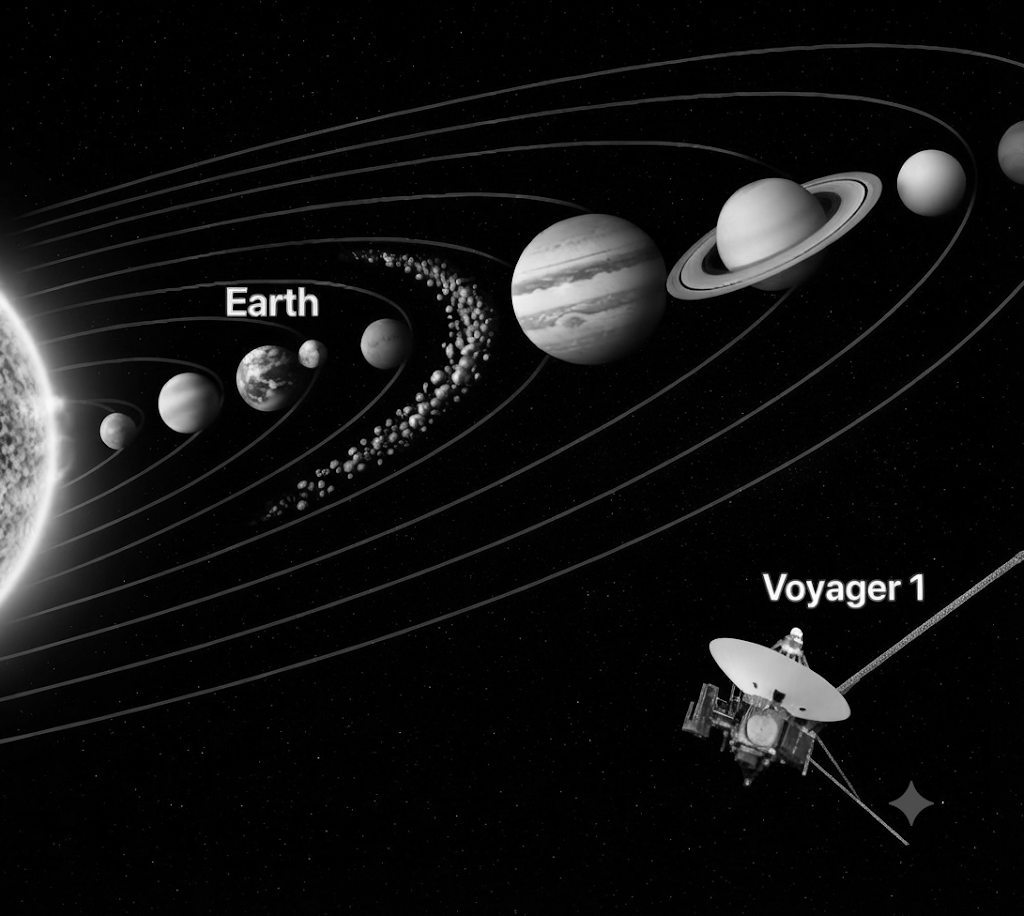
NASA’s Voyager 1 has reached a distance so vast that a radio signal now takes an entire day to travel between the spacecraft and Earth. On November 18, 2026, the probe crossed the one-light-day mark, becoming the first human-made object to reach this distance from our planet.
A light-day is the distance light travels in 24 hours, approximately 25.9 billion kilometres (16.1 billion miles). This means a message sent from Earth takes about 24 hours to reach Voyager 1, while its reply takes another 24 hours to return. Any exchange with the spacecraft now involves a wait of nearly two days.
Launched on September 5, 1977, Voyager 1 was originally designed to explore Jupiter and Saturn, studying their atmospheres, rings, moons and magnetic fields. Its journey was planned around a rare alignment of the outer planets, which occurs roughly once every 176 years. This allowed the spacecraft to use the planets' gravity to travel from one to another. Its twin, Voyager 2, launched a few weeks earlier and went on to explore Uranus and Neptune as well.
Voyager 1 made several important discoveries during its planetary encounters, including new moons of Jupiter and Saturn, a thin ring around Jupiter and volcanic activity on Jupiter's moon Io. It also provided detailed observations of Saturn and its rings.
In August 2012, Voyager 1 became the first spacecraft to enter interstellar space, the region beyond the Sun's protective bubble of particles and magnetic fields, known as the heliosphere. Voyager 2 followed in November 2018. The two probes remain the only spacecraft to have directly explored this region.
Its mission has now shifted from planetary exploration to studying the space between stars. Voyager 1's remaining scientific instruments are designed to measure magnetic fields and plasma waves, helping scientists understand the interstellar environment and how it interacts with the Sun's influence. Most of its other instruments have been switched off to conserve power. The spacecraft runs on electricity generated by the heat from decaying plutonium, and its power supply declines by about four watts every year.
However, the probe is currently facing a communication problem. On November 14, NASA's mission team found that Voyager 1 had stopped sending scientific and engineering data, although its carrier signal was still being detected. Engineers are investigating the cause. NASA can still establish its distance through the signal and trajectory calculations, but diagnosing problems takes time because of the 24-hour communication delay.
Voyager 1 also carries the Golden Record, a gold-plated disc containing 115 images, sounds from Earth, music and greetings in 55 languages. It was designed as a message to any extraterrestrial civilisation that might one day encounter the spacecraft. The probe also captured the famous ‘Pale Blue Dot’ photograph of Earth in 1990, showing our planet as a tiny speck from billions of kilometres away.
Voyager 1 is travelling towards the direction of the star Gliese 445 and is expected to pass within about 1.7 light-years of it in roughly 40,000 years. It will not reach or orbit the star. Even after its power runs out and communication with Earth ends, the spacecraft will continue drifting through the Milky Way.