
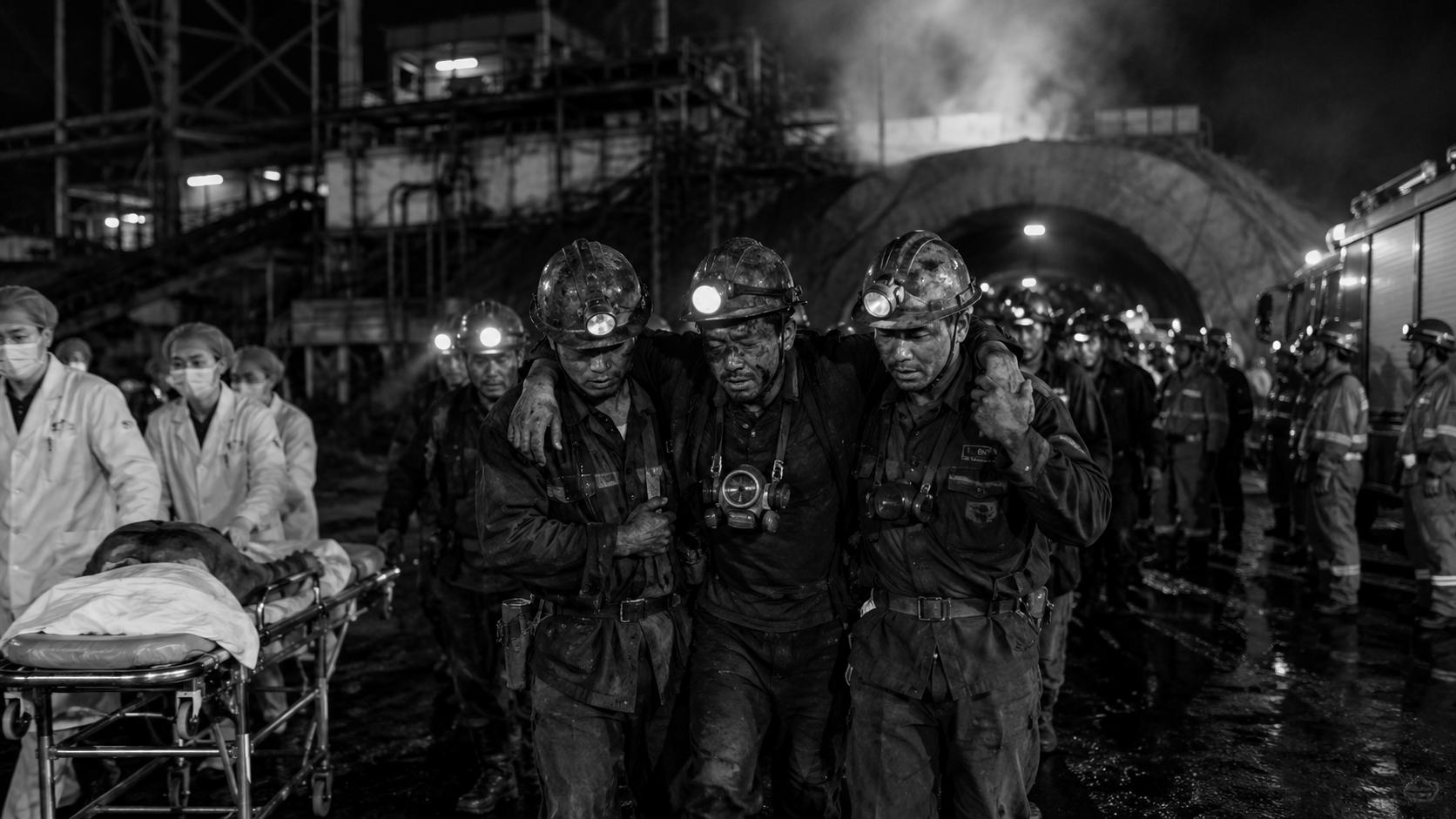
90 Killed, 9 Missing After Shanxi Mine Explosion, China’s Deadliest in a Decade
At 19:29 on Friday, May 22 , a gas explosion tore through the Liushenyu Coal Mine in Qinyuan County, Changzhi City, Shanxi Province killing at least 90 people . Of the 247 workers underground at the time, more than 120 were hospitalized , many suffering from toxic gas inhalation , and nine miners remain unaccounted for as rescue operations continue into Saturday. It is China's deadliest mining disaster in over a decade and a disaster the paperwork saw coming.
A hospitalised miner named Wang Yong said that he smelled sulfur "like firecrackers" and saw smoke filling the tunnels. "I told people to run," he said. "As I ran, I saw people being choked by the smoke. And then I blacked out." His account is the clearest human window into what those 247 workers faced underground at 7:29 on a Friday evening.
Before the explosion, authorities had already been alerted that an underground carbon monoxide sensor had triggered an alarm , indicating CO levels had "exceeded limits." What happened between that warning and the blast, whether management evacuated workers, whether the alarm was acted upon at all, is now under criminal investigation. Mine executives have been detained , and the answer to that question will determine whether this was negligence or something worse.
The mine is operated by Shanxi Tongzhou Coal & Coke Group , with an annual production capacity of 1.2 million tonnes , and was placed on China's national list of disaster-prone mines in 2024 specifically for having "high gas content." It was also among 1,128 mines cited for "severe safety hazards" by the National Mine Safety Administration that same year. It was flagged twice. It kept operating with 247 workers underground. Making the rescue even harder: blueprints provided by the mine did not match the actual underground layout , a detail that is either breathtaking incompetence or something more deliberate, and that almost certainly cost lives in the critical early hours of the search.
President Xi Jinping called for an all-out rescue and ordered those responsible to be held accountable. The Ministry of Emergency Management deployed 345 personnel from six rescue teams , with 400 to 500 people conducting underground operations by Saturday. Province-level leaders arrived at the site. The machinery of visible state response moved quickly, as it always does in China after mining disasters.
The historical pattern is the hardest part of the story. In November 2009 , an explosion in Heilongjiang killed 108 miners . In February 2023 , a collapse in Inner Mongolia killed 53 . After each, Beijing announced stricter regulations, tighter oversight, heavier penalties. After 2023, new rules specifically placed greater burdens on operators and local officials for safety checks. Shanxi Province alone extracts nearly one-third of China's total coal output , 1.3 billion tonnes last year, dug by hundreds of thousands of miners powering an economy where coal still accounts for over half of all energy consumption. The scale of that dependency is the structural reason these disasters keep happening. Every crackdown runs into the same arithmetic: coal is too important to slow down, safety is too inconvenient to enforce rigorously, and the miners are the ones who pay.
The initial state media death toll was eight . It became 90 without explanation. Nine are still missing.