

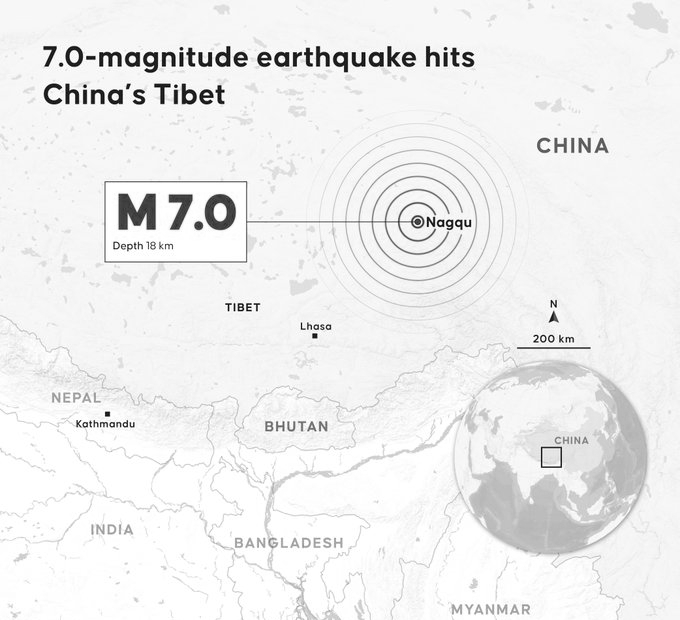
7.0-Magnitude Earthquake Hits Tibet, 16 Dead, 76 Injured as Thousands Evacuated
A powerful magnitude 7.0 earthquake struck China's Tibet region on Thursday night, killing at least 16 people, injuring 76 and leaving hundreds of homes in ruins. Rescue and relief operations continued on Friday as authorities evacuated residents, assessed structural damage and prepared for further seismic activity.
The earthquake hit the northern Tibetan city of Nagqu at around 10.33 pm local time on October 22. At least 339 homes and 20 livestock sheds collapsed, while several other buildings developed cracks, raising concerns about further damage.
More than 12,000 people were evacuated from affected areas as emergency teams worked to locate those in need of assistance. The injured were being treated, with earlier reports indicating that some had sustained serious injuries.
Authorities deployed police, firefighters and other emergency personnel to assist residents, inspect damaged buildings and establish temporary shelters. Relief supplies, including around 3,000 tents, 1,000 prefabricated housing units, folding beds, flashlights and winter clothing, were being sent to the affected region.
The earthquake was followed by 413 aftershocks, complicating rescue efforts and heightening concerns about the safety of weakened structures. Railway services through affected areas were suspended as a precaution, while rockfalls forced the closure of part of National Highway 317. Power and communication services were also disrupted in some locations.
The region's high altitude, freezing conditions and forecast snowfall over the next three days could further hamper rescue and relief operations.
Chinese President Xi Jinping called for all-out search-and-rescue efforts, prompt medical treatment for the injured and measures to minimise casualties.
Nagqu lies more than 300 km north of Lhasa, the Tibetan regional capital. The earthquake's epicentre was located about 191 km east-northeast of Nagqu, in a sparsely populated, high-altitude area. Estimates of its depth varied, with assessments placing it between 10 km and 18 km.
The quake was described as the strongest to hit the region in five years, underscoring the seismic risks facing the Tibetan Plateau, where the Indian and Eurasian tectonic plates interact.