
6.9-Magnitude Earthquake Shakes Russia’s Kamchatka, Residents Flee Homes
A powerful 6.9-magnitude earthquake struck Russia’s far-eastern Kamchatka Peninsula on Friday, sending tremors through residential buildings and prompting some residents to flee their apartments as fixtures swung, doors slammed and household utensils rattled.
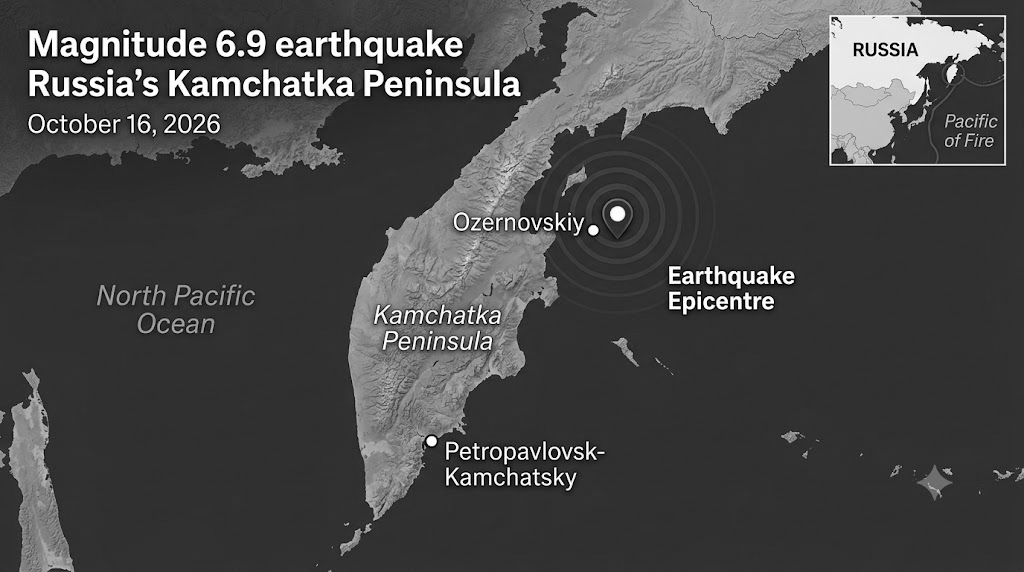
The US Geological Survey (USGS) initially located the earthquake 76 km northeast of Ozernovskiy, at a depth of around 143 km. The magnitude was first estimated at 6.5 before being revised to 6.9 as scientists refined their measurements.
The tremors were felt in Petropavlovsk-Kamchatsky, Kamchatka’s administrative centre, where seismologists reported shaking equivalent to intensity five. The earthquake’s epicentre was also described by Russian scientists as being on land, around 156 km southwest of the city, at a depth of approximately 138 km.
According to eyewitness accounts carried by Russian state news agency TASS, the shaking began at around 3.36 pm local time and continued for approximately one minute. Inside homes, light fixtures swung violently, doors slammed shut and tableware rattled, prompting some residents to evacuate their apartments.
The difference between the initial USGS location and the measurements cited by Russian scientists reflects variations in preliminary seismic assessments. The reported magnitude was subsequently revised as monitoring data became available.
No immediate confirmation of deaths or major structural damage was included in the initial reports. The full extent of the earthquake’s impact was therefore not immediately clear.
Kamchatka lies along the Pacific Ring of Fire, one of the world’s most seismically active regions, where the movement of tectonic plates generates frequent earthquakes and volcanic activity. Earthquakes in the area can be felt across wide distances, depending on their magnitude, depth and proximity to populated areas.
The latest tremor once again highlighted the seismic risks faced by communities in Russia’s far east, where authorities and scientific agencies routinely monitor ground movements for potential hazards.