
61.56% Gap in Drug-Resistance Testing Capacity Across India: Study
India’s efforts to eliminate tuberculosis (TB) could face a major last-mile challenge, with a new multi-state study identifying significant gaps in access to essential diagnostics and drug-resistance testing across public healthcare facilities. Published in Microbiology Spectrum, the study warns that expanding treatment coverage alone will not be enough unless patients can access timely and accurate diagnosis, particularly at primary and secondary healthcare levels.
The study, “Evaluating the nationwide availability of essential diagnostics for tuberculosis toward achieving a TB-free India,” assessed 327 public healthcare facilities across seven states and Delhi, alongside national data on TB Treatment Units and Culture and Drug Susceptibility Testing (CDST) laboratories. It found a 61.56% shortfall in CDST capacity, with the underlying dataset recording 97 laboratories against a recommended 283. The study also identified 6,308 TB Treatment Units against a recommended 7,084, leaving a gap of 776 units.
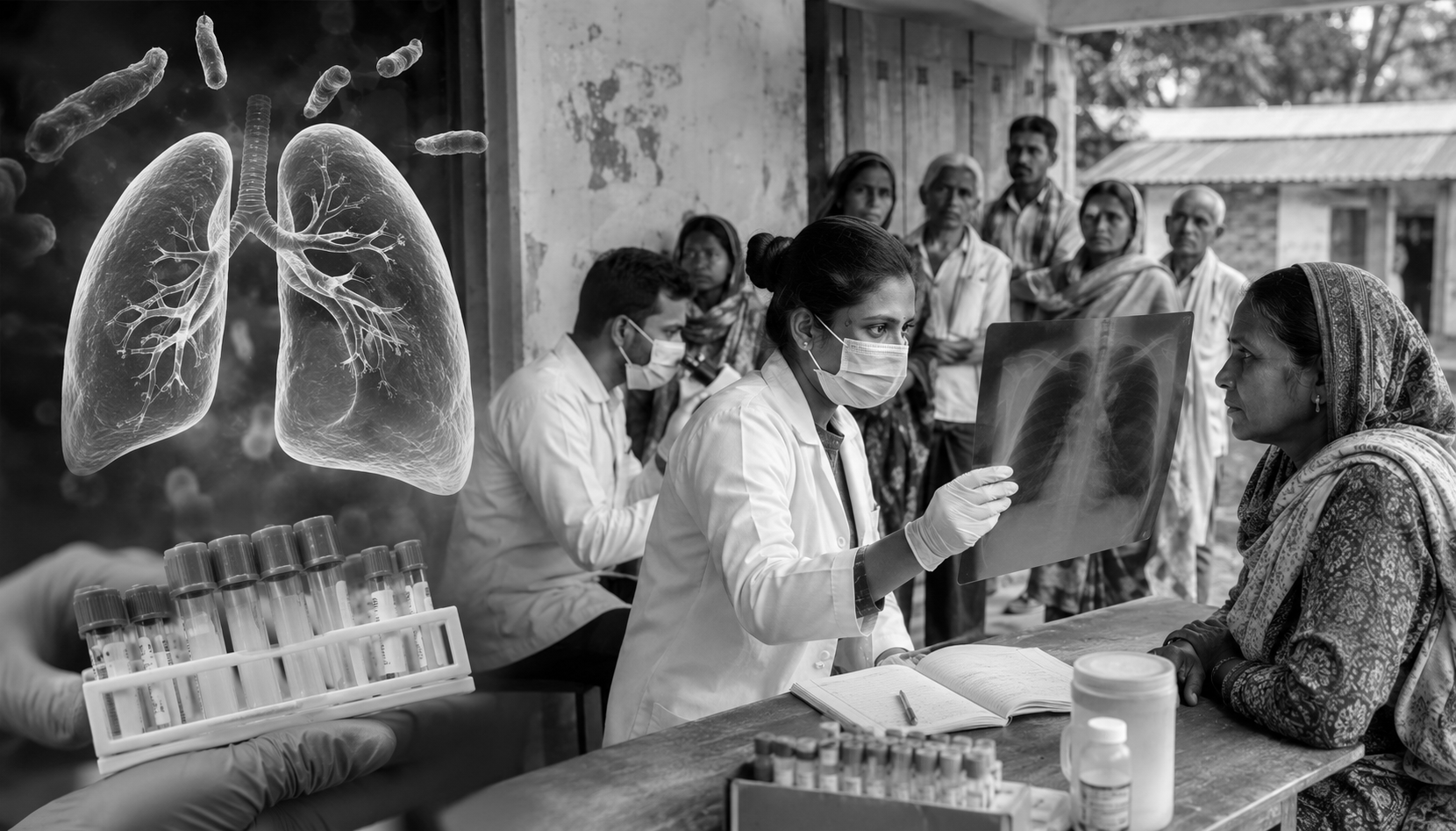
The sharpest deficiencies were at the grassroots. Only 4.94% of surveyed Primary Health Centres (PHCs) had the complete essential TB diagnostic package. Overall availability ranged from 10.32% to 66.67% across the surveyed states and Delhi. AFB smear microscopy was available at 78.46% of facilities, while X-ray and CBNAAT services were each available at 51.28%. Fluorescence microscopy was available at only 30.95%. At PHCs, X-ray availability ranged from just 0% to 10%.
The findings are particularly significant for drug-resistant TB. WHO estimates that India accounted for 32% of global MDR/RR-TB cases in 2024. The researchers call for rapid molecular diagnostics to be expanded closer to patients, particularly through CHCs and, where feasible, PHCs, alongside a stronger culture and drug-susceptibility-testing network.
The study also found gaps in treatment-monitoring tests. CBC availability at PHCs was 49.52%, while CMP testing also remained inadequate at some primary and secondary facilities. Such tests are important for monitoring treatment response and detecting adverse effects of anti-TB medicines.
The findings come despite substantial progress in India’s TB response. Government data show estimated incidence declined 21%, from 237 per lakh population in 2015 to 187 per lakh in 2024. Treatment coverage exceeded 92%, treatment success reached 90%, and TB mortality declined from 28 to 21 per lakh. India had also expanded to 107 CDST laboratories and 9,391 rapid molecular testing facilities by 2025, while more than 500 AI-enabled handheld X-ray units were available, with another 1,500 being supplied.
The authors stress that installing molecular machines alone will not resolve the problem. Effective TB diagnostics require equipment, reagents, trained personnel, maintenance, referral networks, quality assurance and culture-based drug-susceptibility testing. Next-generation sequencing could broaden resistance profiling but remains constrained by cost, infrastructure, bioinformatics capacity and scalability.
The survey covered 76 sub-centres, 150 PHCs, 78 CHCs and 23 district hospitals and was conducted from November 2023 to April 2025. The researchers caution that operational feasibility and logistical support influenced site selection, making it a multi-state assessment rather than a statistically representative survey of every state.
The study concludes that India’s TB elimination strategy must make diagnostics as comprehensive and equitable as treatment, with stronger peripheral molecular testing, laboratory infrastructure, trained manpower and referral networks to reduce missed diagnoses and detect drug resistance earlier.