
61 Crore Jobs by 2047: IIT Roorkee’s Bold Plan for India’s Future
At a time when India is preparing to mark 100 years of independence, Indian Institute of Technology Roorkee has positioned itself at the centre of a crucial national conversation. Hosting the international conference “Vision 2047: Prosperous and Great Bharat 2.0,” the institute brought together policymakers, academicians, and industry leaders to shape a long-term development roadmap.
The headline announcement, a plan targeting 61 crore employment opportunities , immediately captured attention. But beyond the number lies a deeper narrative. This is not a promise of creating 61 crore new salaried jobs . Instead, it represents a broad employment ecosystem , including self-employment, gig work, entrepreneurship, agriculture, and emerging sectors.
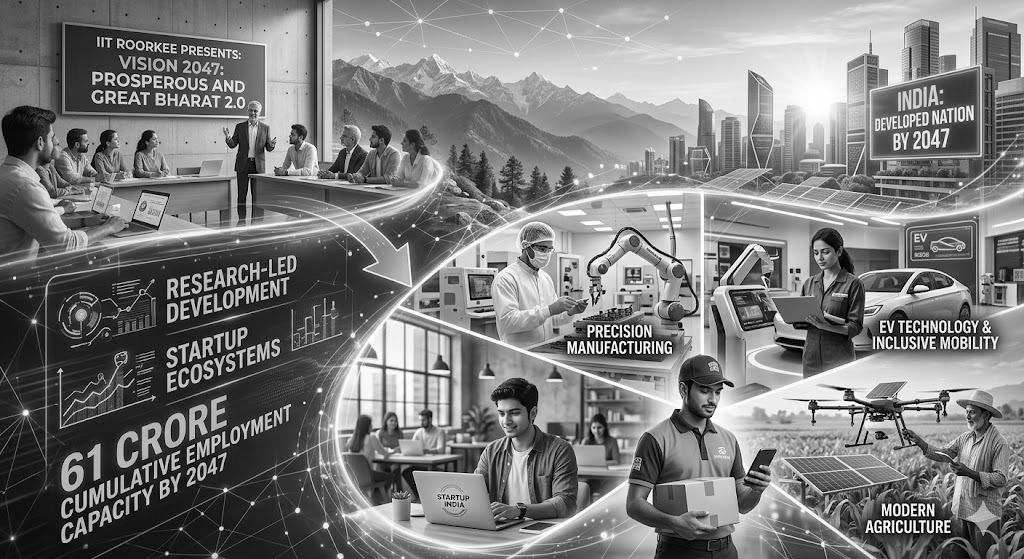
Organised in collaboration with Swadeshi Shodh Sansthan, the conference focused on building a self-reliant and globally competitive India , where employment is driven by innovation and industry-linked growth. Leaders emphasised that future job creation must come from research-led development, startup ecosystems, and strong policy frameworks .
Yet, the scale of the ambition invites a natural question: Is 61 crore jobs even possible?
India’s population currently stands at around 140 crore, but the actual workforce is far smaller. Not everyone is part of the labour market, and a significant portion is already engaged in informal or underpaid work. This means the 61 crore figure is best understood as a long-term cumulative employment capacity by 2047 , rather than a sudden expansion.
For such a vision to become reality, India would need sustained high economic growth , rapid industrial expansion, and a massive upgrade in skills and education systems . Increasing female workforce participation and improving job quality will be equally critical. Without these structural shifts, the number risks remaining aspirational.
The conference also reflected this balance between ambition and action. The launch of a proposed National Employment Policy signalled intent to align skills with future industries. Meanwhile, initiatives like the Centre for Precision Manufacturing and demonstrations at the EV laboratory showcased how innovation is already translating into practical solutions, including inclusive mobility technologies.
What emerged from the discussions was clear: India’s path to becoming a developed nation will not be measured by growth alone, but by the scale and quality of employment it can generate.
The 61 crore jobs vision, therefore, is less a guarantee and more a direction, a bold benchmark that challenges the country to rethink how it creates work, builds skills, and sustains livelihoods over the next two decades.