
5.1 Magnitude Earthquake jolts Central Assam, No casualties reported
A 5.1-magnitude earthquake struck central Assam in the early hours of Monday, triggering brief panic among residents but causing no reported loss of life or significant property damage . Seismologists noted that while earthquakes of this strength can cause minor damage under certain conditions, the relatively deep origin of the tremor reduced its destructive impact, preventing serious structural harm.
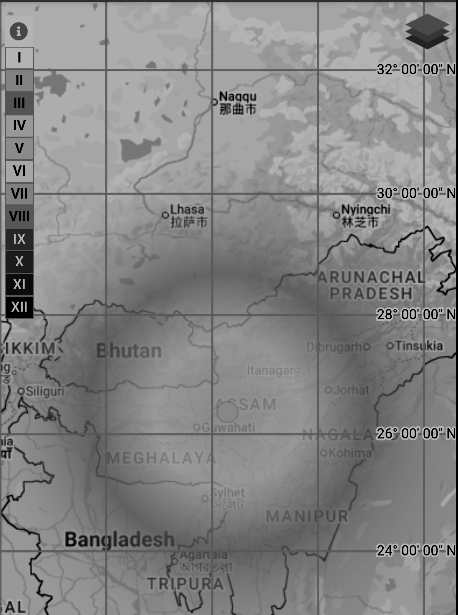
The National Centre for Seismology (NCS) said the quake occurred at 4.17 a.m. , with its epicentre located in Morigaon district on the southern bank of the Brahmaputra river. The earthquake originated at a depth of around 50 kilometres , with coordinates recorded at 26.37 degrees north latitude and 92.29 degrees east longitude .
The tremor was felt across a wide swathe of Assam, including districts such as Kamrup Metropolitan, Nagaon, Hojai, Golaghat, Jorhat, Sivasagar, Cachar, Karimganj, Hailakandi, Dhubri and Goalpara , among others. Several districts on the northern bank of the Brahmaputra also experienced shaking, prompting residents to rush out of their homes as a precaution.
Beyond Assam, the earthquake was sensed in parts of Arunachal Pradesh, Meghalaya, Nagaland, Manipur, Mizoram, Tripura and West Bengal. Reports also indicated mild tremors in Bhutan, Bangladesh and bordering regions of China, underscoring the wide impact of the seismic event.
Officials said preliminary assessments did not indicate any significant structural damage or injuries, and normalcy returned shortly after the tremors subsided.
The northeastern region falls under Seismic Zone V , India’s highest earthquake-risk category , due to its position along the active boundary between the Indian and Eurasian tectonic plates . Continuous tectonic movement along fault systems such as the Kopili Fault and the Indo-Burma range results in frequent seismic activity, with small tremors occurring regularly and moderate earthquakes striking every few years, underscoring the region’s long-term vulnerability to stronger quakes.
Geologists point out that the Northeast lies within the Himalayan seismic belt , where tectonic stress has historically been released through powerful earthquakes. The region last witnessed a devastating event in August 1950 , when an 8.6-magnitude Assam-Tibet earthquake caused widespread destruction. While Monday’s tremor was moderate, experts warn that the underlying tectonic setting continues to make the region susceptible to major seismic events in the future.
Authorities continue to monitor the situation and have advised residents to remain alert, reiterating the importance of earthquake preparedness in this high-risk zone.