
4.74 Lakh Water Bodies in Maharashtra, Five States Record Declines
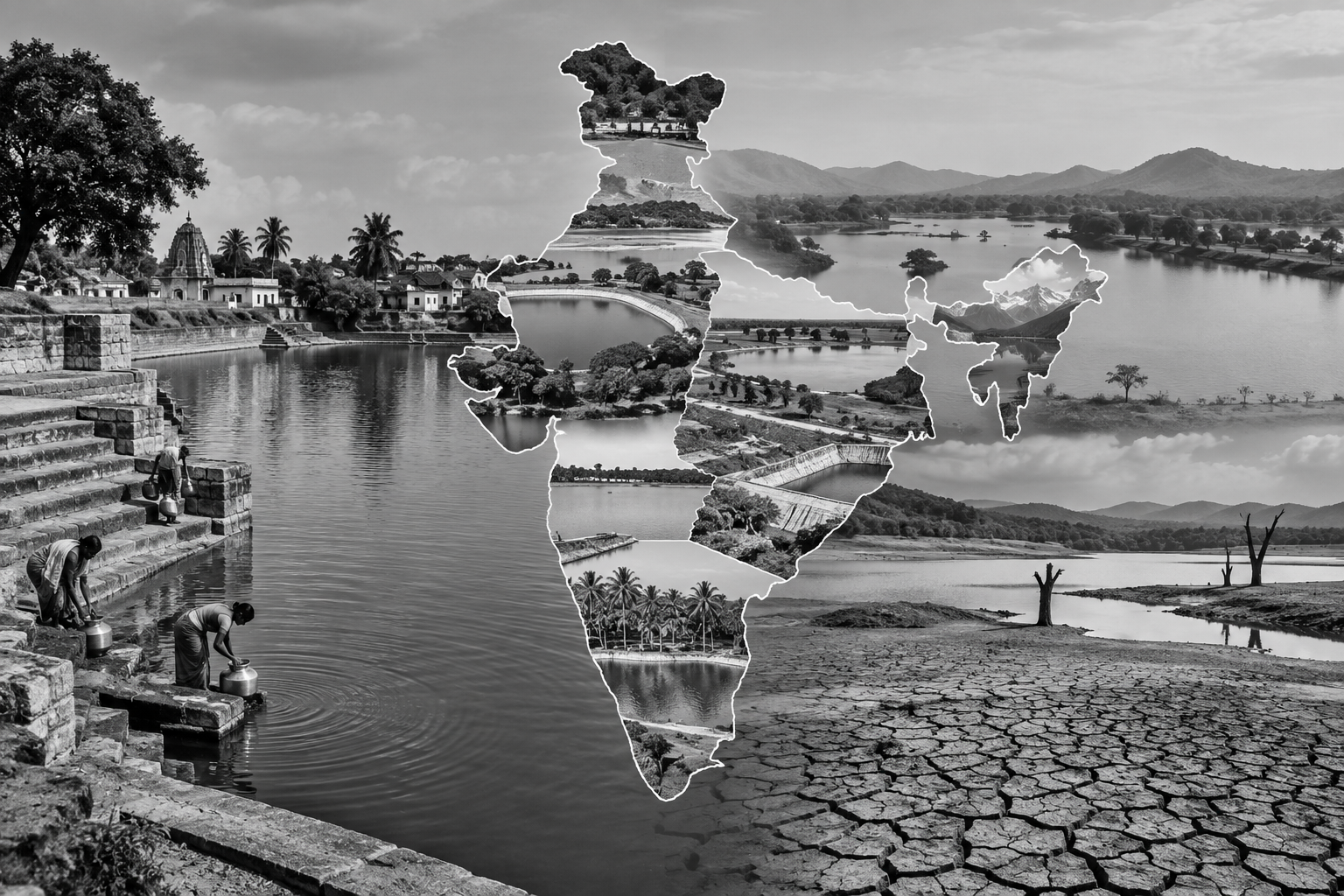
India’s latest Census of Water Bodies has revealed a sharply uneven picture of the country’s local water resources, with Maharashtra recording a dramatic increase in the number of enumerated water bodies while five states, including Telangana and Rajasthan, reported declines. The findings offer an important new database for assessing the condition, use and ownership of ponds, tanks, lakes and other water-storage structures and could shape future planning for irrigation, groundwater recharge, drinking water, conservation and climate resilience.
The findings are part of Volume II, Part II of the Second Census of Water Bodies, covering 19 states and the Union Territories of Chandigarh and Jammu and Kashmir. The report was released by Union Jal Shakti Minister C R Patil during the valedictory ceremony of the ninth India International Water Week at Bharat Mandapam in New Delhi on September 25. The second census, launched on April 3, 2025, uses 2023-24 as its reference year, building on the first census conducted for 2017-18.
The latest exercise records the type, ownership, condition, use, storage capacity, filling status and encroachments of water bodies across rural and urban areas. The first census had identified 24,24,540 water bodies nationwide, with 97.1 per cent in rural areas. More than 72 per cent had a water-spread area below 0.5 hectare, while 38,496 were reported to have encroachments.
Maharashtra recorded 4,74,548 water bodies, compared with 97,062 earlier, an increase of 388.91 per cent. Nearly 99.72 per cent are rural and ponds account for 61.68 per cent. Among those in use, 98.06 per cent are primarily used for irrigation. Uttar Pradesh reported 2,86,292, up 16.81 per cent, with ponds constituting 96 per cent and panchayats owning 2,63,026.
Karnataka recorded 38,960, up 44.2 per cent, while Punjab reported 18,716, an increase of 16.9 per cent. Jammu and Kashmir recorded 11,766, up 20.5 per cent, with domestic and drinking water supply accounting for 62 per cent of water bodies in use.
The contrasting trend was seen in Mizoram, where numbers fell 63 per cent to 808, followed by Arunachal Pradesh at 50 per cent to 499. Jharkhand declined 19 per cent to 86,708 and Telangana 16.19 per cent to 53,685. Rajasthan fell 15 per cent to 14,400; 11,783 remain in use, while 2,617 are not. Of these, 26.63 per cent had dried up and 1.64 per cent were affected by siltation.
The government is using the census alongside programmes such as Mission Amrit Sarovar, RRR of water bodies and AMRUT 2.0 to support restoration. The census is ultimately intended to turn detailed information on India's water assets into more targeted conservation, groundwater management and climate-resilience measures.