
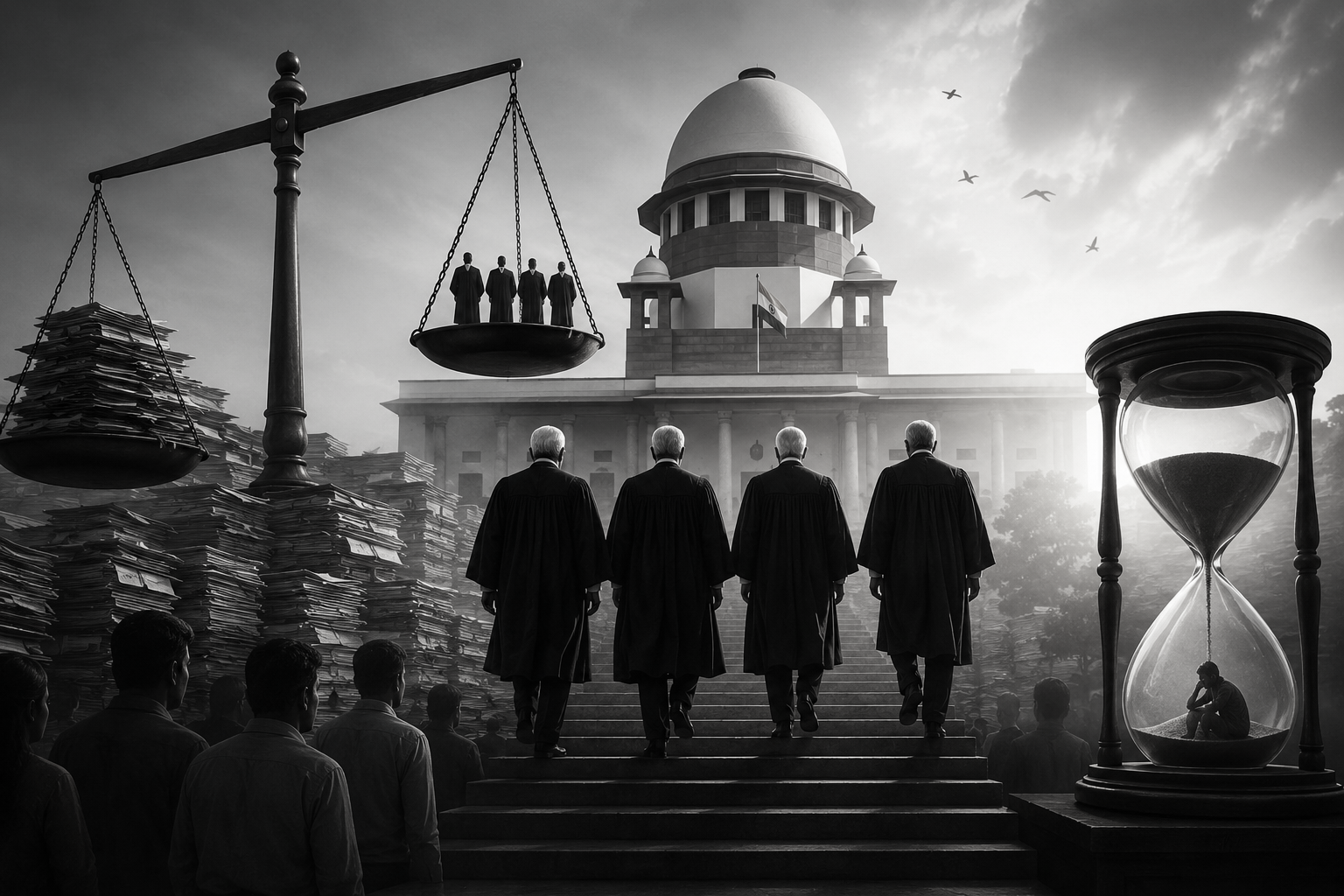

4 New Judges, 80,000 Pending Cases: Centre Expands Supreme Court Bench in Bid to Fix Justice Delays
India's Supreme Court will soon have four additional judges after the Centre issued an ordinance on Saturday amending the Supreme Court (Number of Judges) Act, 1956 , raising the sanctioned strength of the apex court from 34 to 38 , including the Chief Justice of India . The move, notified by the Union Law Ministry , comes into effect immediately, meaning the court can now seat 37 judges alongside the CJI. It is the first such expansion since 2019, and by most accounts, it is long overdue.
The numbers tell a sobering story. The Supreme Court is currently burdened with over 80,000 pending cases , constitutional matters, criminal appeals, civil disputes, and public interest litigations, many of which have languished in the queue for years, some for over a decade. Convicts sit in prison awaiting verdict dates. Citizens fighting for fundamental rights wait years for hearings. Governance disputes that affect millions of people crawl through a system stretched well beyond its intended capacity. For a court meant to be the last word on justice in a nation of 1.4 billion , the backlog is not a statistic, it is a daily failure.
The roots of this crisis run deep. When the Supreme Court was established under the 1956 Act , it had just 10 judges besides the CJI, a number designed for a newly independent country with limited formal litigation culture. As India's economy expanded, its population multiplied, and its citizens grew more legally assertive, the caseload ballooned. The government responded with incremental amendments in 1960, 1977, 1986, 2009 , and most recently in 2019 , when the strength was raised to 34. Each increase bought temporary relief before the weight of pending cases surged again. The pattern has repeated itself for seven decades.
With Parliament not in session, the Centre has used the ordinance route , a constitutional provision under Article 123 allowing the President to promulgate legislation in urgent circumstances. The ordinance has immediate legal force but must be ratified by Parliament within six weeks of its reassembly. The government is expected to introduce a formal replacement bill during the Monsoon Session . The use of this route signals both the urgency the executive attaches to the matter and the recognition that waiting for the next session would mean continued paralysis.
On the ground, the practical impact hinges on how quickly the Collegium acts. With two vacancies already existing before this ordinance, the apex court's recommendation body must now identify and clear six names for appointment. More judges means more benches sitting simultaneously, more matters taken up per day, and shorter gaps between filing and first hearing. It also opens the possibility of greater specialisation, dedicated benches for commercial disputes, environmental matters, and constitutional questions that demand sustained, undistracted judicial attention.
Yet legal experts are measured in their optimism. The Supreme Court's backlog, while alarming, is one layer of a much larger systemic crisis. High Courts across India collectively carry over five lakh pending cases . District courts are worse still. Judicial vacancies, inadequate infrastructure, and slow appointment pipelines compound the problem at every level. Four judges at the top, however symbolically significant, cannot by themselves fix a system where delays begin long before a case reaches the apex court.
What the ordinance does represent, unambiguously, is acknowledgment, that the status quo is untenable, that the burden on sitting judges is unsustainable, and that the state has a constitutional and moral obligation to keep the promise of timely justice . Whether this expansion is followed by deeper reforms in case management, court infrastructure, and appointment processes will determine whether Saturday's ordinance is remembered as a turning point or merely the latest in a long line of incremental adjustments to a court that keeps outgrowing its own design.