
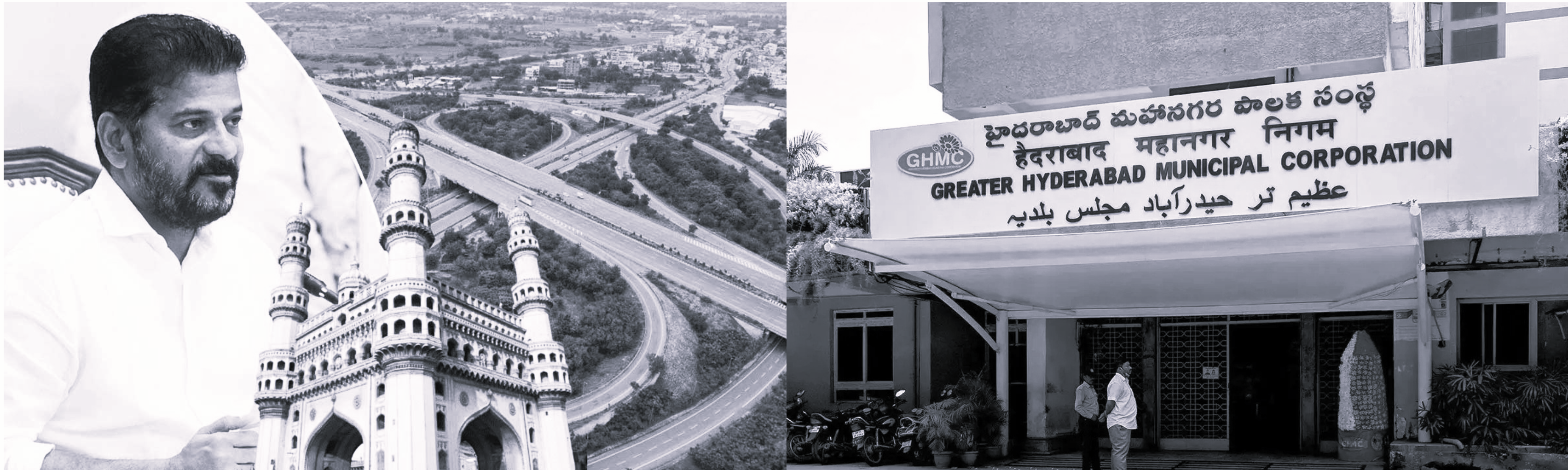
27 municipalities to merge with GHMC as cabinet approves urban overhaul
The Telangana Cabinet has approved a major restructuring of urban governance by merging 27 municipalities and municipal corporations located in and around the Outer Ring Road (ORR) into the Greater Hyderabad Municipal Corporation (GHMC). The decisions were taken at a Cabinet meeting chaired by Chief Minister A. Revanth Reddy at the Dr. B.R. Ambedkar Telangana Secretariat on Tuesday. The municipalities set to be merged include Pedda Amberpet, Jalpally, Shamshabad, Turkayamjal, Manikonda, Narsingi, Adibatla, Tukkuguda, Medchal, Dammaiguda, Nagaram, Pocharam, Ghatkesar, Gundlapochampally, Thumkunta, Kompally, Dundigal, Bollaram, Tellapur, Ameenpur, Badangpet, Bandlaguda Jagir, Meerpet, Boduppal, Peerzadiguda, Jawaharnagar, and Nizampet. To facilitate the merger, amendments will be made to the GHMC Act and the Telangana Municipal Act, ministers Mallu Bhatti Vikramarka, D. Sridhar Babu, Uttam Kumar Reddy, Jupally Krishna Rao, and V. Srinivas Goud announced.
The Cabinet also approved an ambitious plan to convert Hyderabad’s overhead electricity network into a completely underground cable system, following the model implemented in Bengaluru. Officials estimate that the project will cost around ₹14,725 crore. For implementation, Hyderabad will be divided into three electrical circles. In addition to power cables, the government plans to shift Telangana-Fiber lines and private cable networks underground, with officials tasked to prepare a detailed working plan and coordinate with all service providers.
To strengthen power distribution, the state will set up a third power distribution company alongside the existing Northern Power Distribution Company of Telangana Limited (NPDCL) and Southern Power Distribution Company of Telangana Limited (SPDCL). All agricultural electricity connections, lift irrigation schemes, Mission Bhagiratha, safe drinking water projects, and Hyderabad Metropolitan Water Supply & Sewerage Board (HMWS&SB) power connections will fall under the new Distribution Company (DISCOM)’s jurisdiction.
The Cabinet reviewed power demand forecasts for the next decade and approved multiple renewable energy initiatives. These include procuring 3,000 MW of solar power and 2,000 MW of pumped storage power through short-term (five-year) contracts. Companies will also be permitted to set up pumped storage plants in suitable locations across the state, facilitating 10,000 MW of such projects, with the government providing land and water. All power generated under these initiatives must be sold to the state’s DISCOMs first. Under the new “Clean and Green Energy Policy,” new industries will be allowed to produce captive power without any cap on generation capacity, while existing industries will continue under current power supply norms.
Regarding thermal power, the government decided that the proposed 800 MW plant at Ramagundam Thermal Power Station will be taken up by NTPC. Feasibility studies will also be conducted for potential NTPC-operated plants at Palvancha and Makthal. Officials were asked to compare tariff estimates between NTPC and the state’s Generation Company (GENCO) before granting final approval.
Key land allotments and new institutions were also cleared. Twenty-point-two-eight acres at Peddanallabelli village (Dummugudem mandal, Bhadradri Kothagudem) were allocated for an SC, ST, BC Young India Integrated Residential School. Forty acres at Jagganapet village (Mulugu) were allocated for a new Sports School. Approval was granted for a new Advanced Technology Centre in the Jubilee Hills constituency, along with ATCs in six additional ITIs, supplementing the 56 existing centres.