
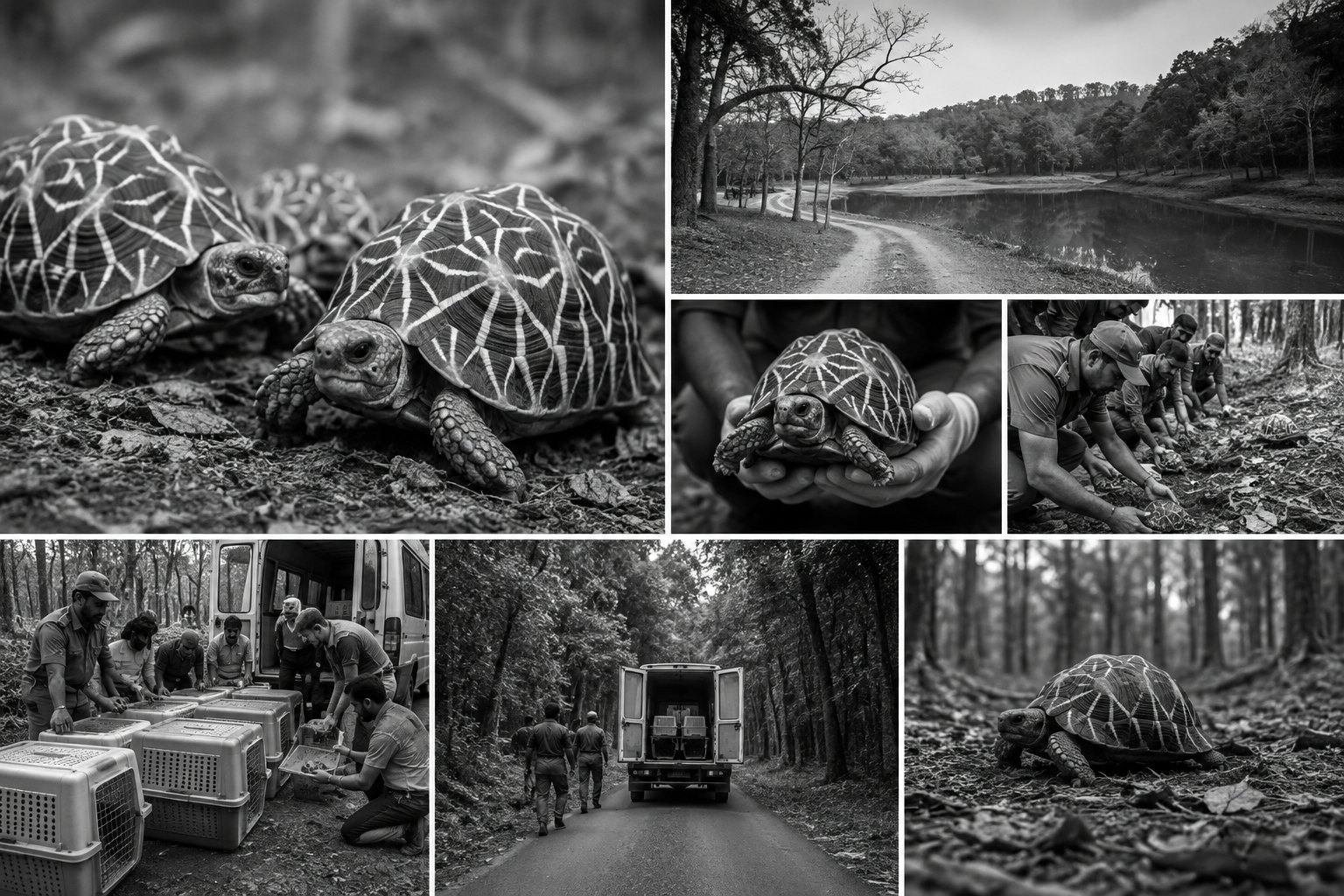
216 Rescued Indian Star Tortoises Released in Tadoba Under Project STRIPES
Project STRIPES (Star Tortoise Repatriation Initiative Protecting Endangered Species) is driving a major conservation effort to return Indian Star Tortoises rescued from wildlife trafficking to suitable natural habitats. As part of the initiative, 216 tortoises rescued or seized from Mumbai and Thane have been rehabilitated and repatriated to the Tadoba-Andhari Tiger Reserve (TATR) in Maharashtra’s Chandrapur district, marking the launch of a structured and scientifically managed programme for the species.
The initiative is a joint effort of the Maharashtra Forest Department and Resqink Association for Wildlife Welfare (RAWW) and aims to address the recurring recovery of Indian Star Tortoises from wildlife trafficking networks. The programme seeks to move beyond isolated rescue operations by creating a structured system for rehabilitation, health assessment and periodic repatriation of recovered tortoises to suitable habitats.
The 216 tortoises were seized during various enforcement operations against illegal wildlife trafficking and rescued through separate interventions across Mumbai and Thane. Of the total, 150 were rehabilitated under RAWW’s care, while others were housed at the Forest Department’s Thane Transit Treatment Centre (TTC) and facilities associated with TCPCA, PAWS and WWA.
A 10-member team comprising wildlife experts, Maharashtra Forest Department personnel from the Mumbai Range and RAWW staff handled the repatriation. The operation was carried out under the guidance of Maharashtra’s Principal Chief Conservator of Forests and Chief Wildlife Warden Sreenivas Reddy, with senior Forest Department officials from Mumbai and Thane supervising the exercise.
The tortoises travelled more than 800 km to Tadoba in a specialised RAWW wildlife ambulance. They were transported in ventilated, cushioned carriers, with scheduled halts to monitor their health and hydration. After reaching the reserve, the animals underwent comprehensive medical re-examination and were kept overnight for rest and observation.
They were subsequently released in batches into designated forest ranges, following conservation protocols and a scientifically determined male-to-female ratio. Tadoba is an ecologically relevant destination, with the Indian Star Tortoise ( Geochelone elegans) recorded among the reserve’s reptile fauna. The release, however, does not indicate that the rescued animals originated there; they were recovered in Mumbai and Thane and returned to a suitable habitat.
The operation comes amid continuing threats from the illegal wildlife and pet trade, which has driven the removal of Indian Star Tortoises from the wild. The species is classified as Vulnerable by the IUCN and has been listed under CITES Appendix I since 2019, providing the highest level of international protection against commercial trade. It is also protected under India’s wildlife laws.
Officials said Project STRIPES is intended to establish a repeatable rehabilitation-and-repatriation framework for trafficked tortoises. The release of 216 animals therefore represents not just a major rescue outcome, but a broader effort to combine wildlife enforcement, specialised care and scientific rehabilitation to return trafficked animals to the wild.