
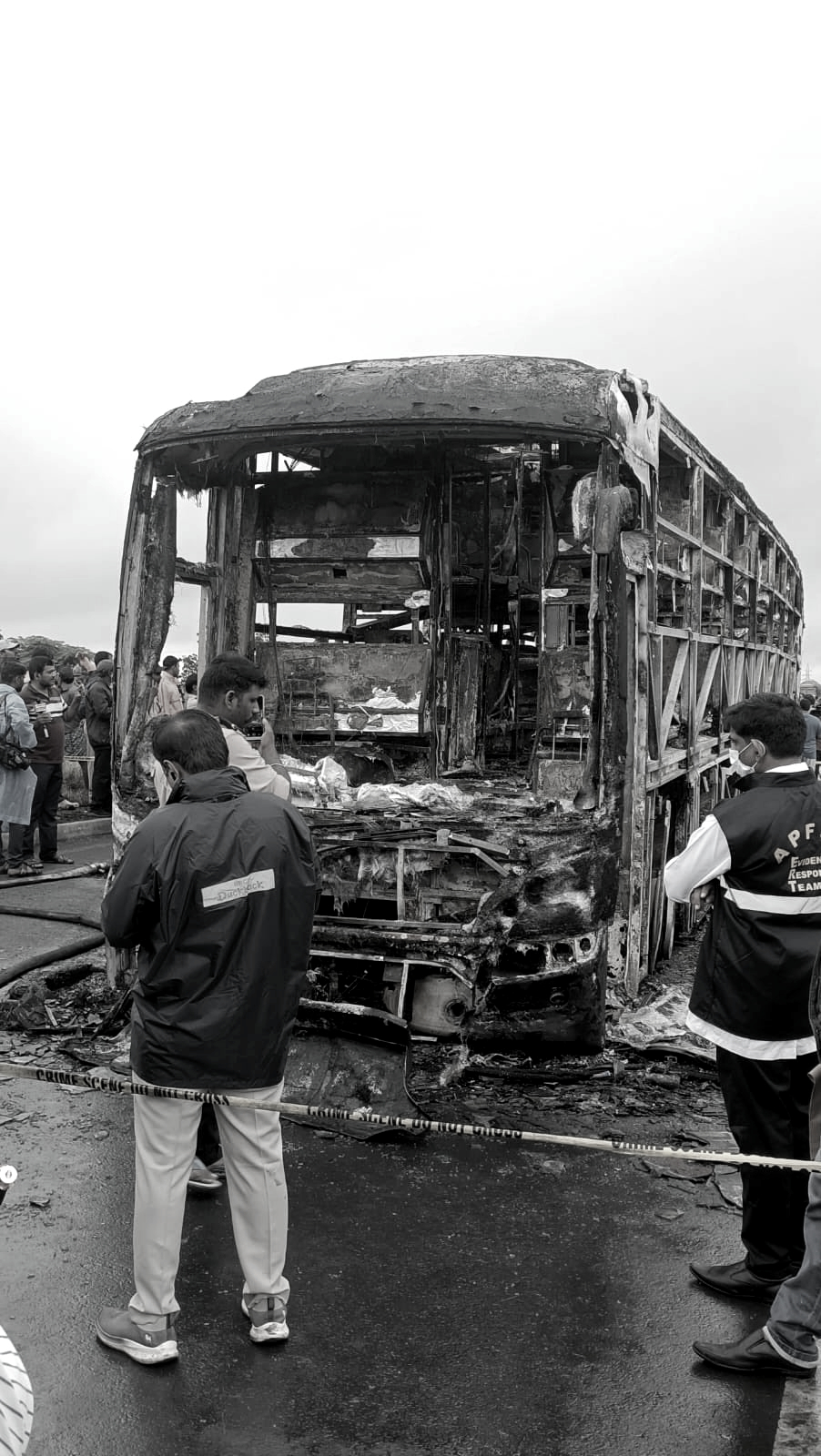
19 Killed in Kurnool bus blaze
A passenger bus named Vemuri Kaveri traveling from Hyderabad to Bengaluru collided with a motorbike near Kurnool early Friday morning and caught fire, resulting in the deaths of 17 adults and two minors, Andhra Pradesh Home Minister Anitha confirmed. The incident occurred around 3:00 AM.
The bus was carrying 39 passengers at the time of the accident. Survivors reported that the doors were locked, forcing some passengers to break emergency windows to escape. Eyewitness Jayant Kushwaha described waking up to flames and struggling with others to get out, while another passenger, Ashwin, said roughly 20 people managed to jump out, but others were trapped inside.
The bus driver survived, assisting passengers in exiting by breaking the glass, and has been taken into custody for investigation. The motorbike rider, Shiva Kumar, a native of Kurnool, also lost his life. The state authorities noted that the bodies were badly damaged in the fire, making identification difficult. DNA samples are being collected from families, and forensic teams have been deployed to investigate the circumstances of the crash.
Safety systems and regulatory context
Under Indian law, all intercity passenger buses are required to have:
• Functional emergency exits (doors and windows)
• Fire extinguishers and first aid kits
• Speed governors and mechanical fitness certified annually by the Regional Transport Office (RTO)
Despite these mandates, enforcement is inconsistent, particularly in private bus operations. Investigators are examining whether the Kurnool bus complied with its last safety audit and whether emergency systems were operational. As of now, there is no public record of the bus’s last RTO inspection or GPS data.
Speed and Highway Monitoring
The exact speed of the bus at the time of the crash remains unknown. While NH44, the Hyderabad–Bengaluru highway, has speed cameras in certain stretches, coverage is not continuous, especially in rural areas. Investigators will rely on forensic accident reconstruction, skid marks, vehicle instruments, and eyewitness accounts to determine the bus’s speed.
Preventive Measures and Global Best Practices
Experts highlight that many fatal bus accidents in India involve locked doors, inaccessible emergency exits, overspeeding, and driver impairment. Globally, countries with strict enforcement and technology have significantly reduced bus-related fatalities:
• Alcohol ignition interlocks: Vehicles cannot start if the driver’s BAC exceeds legal limits. Used in the US, Canada, and parts of Europe, these systems prevent drunk driving.
• Speed-limiting technology: Intelligent Speed Assistance (ISA) and GPS tracking can prevent overspeeding automatically.
• Mandatory safety audits: In the US, EU, UK, and Australia, buses undergo annual inspections of mechanical fitness and emergency systems, with pre-trip checks and random roadside enforcement.
If implemented rigorously in India including monthly or annual audits, alcohol interlocks, speed governors, and emergency system checks such measures could prevent tragedies like the Kurnool fire.
Home Minister Anitha confirmed that a case has been registered, and forensic investigations are ongoing.
The Kurnool bus fire tragically underscores the consequences of lapses in emergency preparedness and safety enforcement in private passenger buses. While the exact speed and circumstances are under investigation, experts stress that strict compliance with safety audits, functional emergency systems, speed control, and sobriety checks could prevent similar disasters.
Past major accidents
Private intercity buses in India have witnessed several deadly accidents in the past decade, highlighting recurring safety lapses. In 2013, a private bus in Mahabubnagar, Telangana, fell into a gorge due to overspeeding, killing 20 passengers. In 2020, a bus in Palamaner, Andhra Pradesh, caught fire allegedly due to a short circuit, claiming 14 lives when emergency exits reportedly failed. Himachal Pradesh has also seen tragic incidents, including the 2017 Solan bus fire, which killed nine people when passengers were trapped due to blocked exits, and a 2019 Manali-Bilaspur bus accident that resulted in 15 deaths after a private tourist bus lost control on a hilly curve. These incidents, along with this Kurnool tragedy, underscore the urgent need for strict enforcement of safety audits, functional emergency systems, driver monitoring, and adherence to speed regulations in private passenger buses across the country.